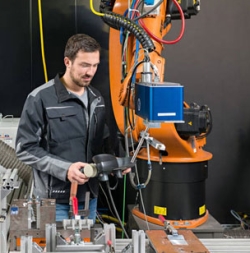
The Technical University of Munich reports that its engineers are optimizing processes to securely fuse metals and thermoplastics by first texturing the metal surface with a laser beam, producing tiny hollows, then applying heat. Laser treatment can produce structures with a depth ranging from nanometers to a few millimeters. “The choice of surface structure for the best bonding properties depends on the material in question,” explains André Heckert, doctoral candidate.
He has discovered that a groove pattern a few tenths of a millimeter deep is particularly suitable for plastics reinforced with short fibers. By contrast, fine surface structures, which are generated with pulsed laser systems, are highly effective in the case of continuous fiber-reinforced plastics.
After the laser texturing stage, the metal and plastic materials are pressed together. The metal is then heated until the plastic melts and flows into the hollows. On cooling, a stable bond is formed between the two materials.
The scientists are using three different methods to create the necessary heat. Here again, a laser beam can generate enough heat to melt the plastic. In friction press joining, thermal energy is created by the friction of a cylindrical tool rotating on the metal surface under a defined pressure.
A completely different and very quick method relies on NanoFoil technology. When it ignites, NanoFoil can briefly reach a temperature as high as 1000 to 1500°C. This heat bonds the plastic and metal together. One possible application for this technology could be the fast joining of metal cable clips to an aircraft fuselage via a thermoplastic intermediate layer.
http://www.tum.de/en/about-tum/news/press-releases/short/article/32885/