A team of chemists, led by Xiaohu Xia from Michigan Technological University, Houghton, found a better way to make metal nanoframe catalysts. The study shows how researchers made a catalyst for the first time out of the noble metal ruthenium. The effort brought together a team from Michigan Tech, Argonne National Laboratory, University of Texas at Dallas, and Temple University. The team’s break-through is not limited to ruthenium, however.
Xia says the process they developed is most important. “We are fine-tuning the surface, size, shape and crystal structure,” he says. “Our goal is to increase their catalytic activity while reducing the usage of this precious material.” The key is more surface area. Nanoframes, which are nanoparticles with open centers, have an advantage with their gazebo-like atomic arrangements. Xia adds that not only shape but crystal structure is important, “because catalytic reactions occur only on the surface of materials, the surface atom arrangement has a great impact on determining the catalytic activity.”
In general, ruthenium nanocrystals adopt the hexagonal close-packed (hcp) structure. But Xia and his team came up with an elegant solution for making ruthenium nanocrystals with another structure: face-centered cubic (fcc) structure.
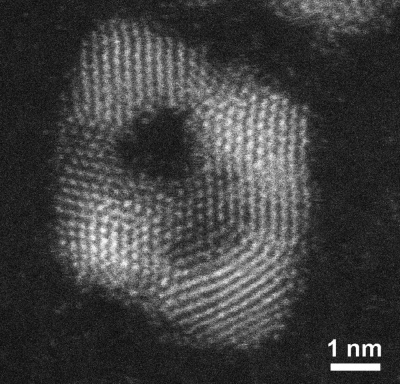
The process involves two steps, growth and etching. Basically, hcp ruthenium doesn’t naturally grow in a crystal structure that can be made into a nanoframe. So, the team directed ruthenium growth on a palladium seed with an fcc structure, which the ruthenium replicated. Then they removed the palladium core, leaving behind an fcc ruthenium nanoframe.
To ensure the material had catalytic potential, the ruthenium nanoframes were run through several diagnostic tests: p-nitrophenol reduction by NaBH4 and dehydrogenation of ammonia borane. While more data is needed to quantify how well ruthenium holds up against existing metal catalysts, Xia says the results from their experiments are promising.
Once the material has been vetted, researchers will be able to start applying the catalyst to several big challenges. Namely, Xia says that ruthenium nanoframes and other catalysts with unique crystal structures could improve hydrogen fuel production and carbon storage.
Image caption — Using a two-part process, ruthenium was turned into a nanoframe—a promising metal catalyst.