The 2016 Pittcon Heritage Award, jointly sponsored by the Pittsburgh Conference on Analytical Chemistry and Applied Spectroscopy (Pittcon) and the Chemical Heritage Foundation (CHF), has been presented to Kenji Kazato (1917-2012) and Kazuo Ito (1921- ), who led a group of scientists in Japan to develop an electron microscope. The award recognizes “outstanding individuals whose entrepreneurial careers shaped the instrumentation and laboratory supplies community, inspired achievement, promoted public understanding of the modern instrumentation sciences, and highlighted the role of analytical chemistry in world economies.”
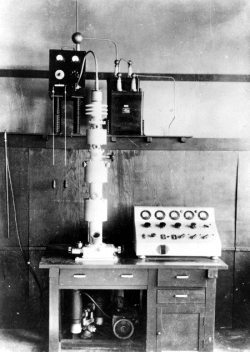
In 1947, Mr. Kazato and Mr. Ito introduced a prototype magnetic field-type electron microscope, the DA-1 (shown in the photo). In 1949, they led their team to found Japan Electron Optics Laboratory (JEOL), with Mr. Kazato presiding over the fledgling company. Shortly afterwards, they offered their first commercially available Transmission Electron Microscope, the JEM-1.
Building on continued success, JEOL expanded into the field of nuclear magnetic resonance (NMR) and introduced the JNM-1 in 1956. JEOL then began manufacturing other types of scientific instrumentation, including Electron Spin Resonance Spectrometers, and by 1966 introduced its first Scanning Electron Microscope. In 1976, JEOL’s electron microscope took the world’s first photomicrograph of atomic arrangement.