Cylinder fatigue can be due to abnormal heating in service, also experienced by piston heads, exhaust valves, and turbosupercharger housings (castings). As a note, pistons from different engines series can sometimes fit, but due to slight design modifications, they may not function properly. Always make sure that the correct piston is used for a specific engine model.
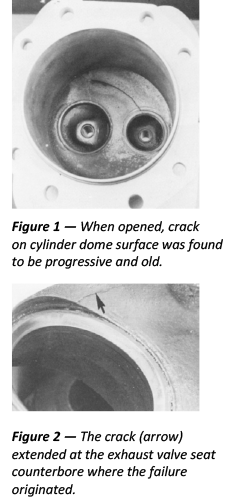
Either or both circumferential cracks and fractures near the head-to-barrel junctions have occurred on numerous cylinders of reciprocating piston engines. In most instances, cracks were caused by high cyclic pressures and high temperatures resulting most probably from detonation. At times, fractures or cracks (or both) were also caused by a combination of (1) unfavorable temperature distribution and possibly excessive pressures around the cylinder barrel, (2) un-nitrided internal surfaces of cylinder barrels, and (3) inadequate thread contours, which caused high stress concentrations at the thread roots. Figures 1 and 2 illustrate one example of the most common type of cylinder failure.
This case history has been adapted from the ASM Failure Analysis Database