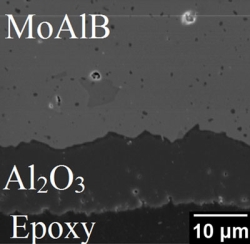
Drexel University, Philadelphia, announces that a research team from Drexel, Linkoping University in Sweden, and Imperial College London, has produced a nanolaminated molybdenum-aluminum-boride coating that resists corrosion at high temperatures. To make the MoAlB coating, Prof. Michel Barsoum and his team combined a molybdenum-boron lattice with a double layer of aluminum to produce a material that is durable enough to resist oxidation at extremely high temperatures. The key to this performance is the material’s nanolaminated structure, which consists of alternating layers of molybdenum boride and aluminum.
Using techniques gleaned from MAX Phase and MXene fabrication techniques developed by Prof. Barsoum, the research group developed a method for making corrosion-resistant layered boride. Upon testing, the group also found that the material retains its high conductivity to elevated temperatures. Its melting point has yet to be determined, but preliminary results have shown it to be greater than 2550°F. Prof. Barsoum speculates that because of these promising results, his team’s work has now laid the foundation for the development of ultrahigh melting point borides that are also oxidation resistant.
According to Prof. Barsoum, “Resistance to oxidation is possible because of the presence of aluminum in layers between molybdenum and boron layers. When heated to high temperatures in air, the aluminum atoms selectively diffuse to the surface and react with oxygen — forming a surface aluminum oxide protective layer that slows down further oxidation considerably.”