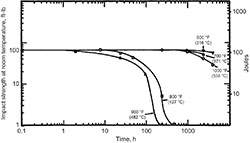
Ferritic stainless steels are quite similar in their mechanical behavior to carbon steel. The main influence of chromium is to produce some solid solution hardening. Intermetallic phases may increase hardness (sometimes usefully) and decrease ductility, notch toughness, and corrosion resistance. The graph shows the influence of alpha prime on toughness.
Because stabilized alloys are ferritic at all temperatures, there is no automatic grain-refining transformation as exists in carbon steel. If grains grow large from annealing at high temperatures or welding, then the transition temperature increases. Section size also has an effect. Stabilized ferritic stainless steels are seldom used in thicknesses of over several millimeters because of decreasing toughness.
Volume 4D, Heat Treating of Irons and Steels -> Heat Treated High-Alloy Steels -> Heat Treating of Ferritic Stainless Steels -> Properties