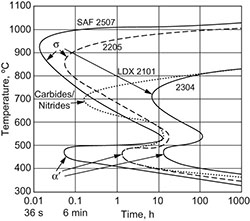
Because of the use of nitrogen as an alloying element in these stainless steels, chromium nitrides (CrN) may be present on α/α grain boundaries, on γ/α boundaries, and within the α grains. If formed in large quantities and under conditions in which the chromium-depleted areas do not have time to repair themselves during annealing, the presence of CrN may adversely affect corrosion resistance.
However, because higher nitrogen promotes more γ- phase, which has a high solubility for nitrogen, most modern DSS steels seldom contain significant amounts of CrN. Furthermore, duplex stainless steels are made with very low carbon content, so that carbide formation to a detrimental extent is not usually a concern. The only exceptions to this are the very lean grades, such as S32101, S32022, and S82011, which can lose corrosion resistance and toughness due to carbide and nitride formation. This is most likely to occur in the 1130 to 1475°F range.
With these very lean grades, the rate of formation of intermetallic compounds is sufficiently slow that the phases most likely to cause a loss of properties are the carbides and nitrides. The kinetics of carbide and nitride formation is similar to that of σ/χ precipitation in the 2205 grade.
Volume 4D, Heat Treating of Irons and Steels ⇒ Heat Treated High-Alloy Steels ⇒ Heat Treating of Austenitic and Duplex Stainless Steels ⇒ Duplex Stainless Steels