Researchers from the Harvard John A. Paulson School of Engineering and Applied Sciences (SEAS), Cambridge, Mass., in collaboration with colleagues from Duke and Yale universities, recently developed a method to predict which alloys might form a bulk metallic glass. “For the first time, we’ve observed a strong correlation between the glass-forming ability of an alloy and properties that we can easily calculate ahead of time,” says Joost J. Vlassak, a materials engineering professor at SEAS.
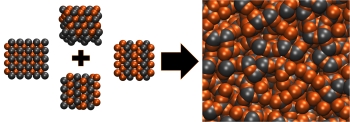
When metal alloys are melted, the atoms lose their ordered structure—although most will snap back to their rigid crystal structures when cooled. However, bulk metallic glasses, if cooled at certain rates, will retain the random amorphous structure even in the solid state. Yet some alloys have more options when it comes to their crystal structures. When these alloys are being cooled into solids, their atoms could crystallize in many different ways. “If a particular alloy composition exhibits many structurally different, stable or metastable crystal phases that have similar formation energies, these phases will compete against each other during solidification,” explains Vlassak. “Essentially, the liquid becomes so confused, it remains amorphous as it solidifies.”
“When you get a lot of structures forming next to one another that are different but still have similar internal energies, you get a sort of frustration as the material tries to crystalize,” adds Eric Perim, a postdoctoral researcher working at Duke. “The material can’t decide which crystalline structure it wants to converge to, and a metallic glass emerges. What we created is basically a measure of that confusion.” The team at Duke developed a database to simulate the hundreds of crystalline structures each alloy could potentially take.
They created a program to analyze the various structures and compare the energy required to form them. Alloys that can form many different structures whose energy is similar are likely candidates to form a metallic glass. The teams at Harvard and Yale then verified the predictions experimentally. The new approach is able to predict the formation of known metallic glasses 73% of the time and has identified hundreds of new candidates for metallic glass made from simple, two-element alloys. Now that the researchers can predict good candidates for metallic glass, they can start looking for new material systems. seas.harvard.edu.
Image caption — When metal alloys are melted, the atoms lose their ordered structure and become amphorous, as seen above. Courtesy of the Vlassak Group/Harvard SEAS.