A lot can be learned about a material from the outermost electrons in its atoms. “These outermost electrons, known as valence electrons, are the most important players in forming chemical bonds and actually define almost every property of a solid—electrical, thermal, conductive,” says Shambhu Ghimire, staff scientist at the Department of Energy’s SLAC National Accelerator Laboratory.
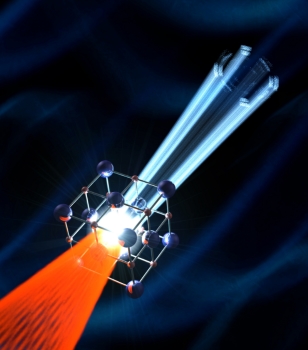
Ghimire and colleagues at the Stanford PULSE Institute invented a new way to probe the valence electrons of atoms deep inside a crystalline solid. They use laser light to excite some of the valence electrons, steer them around inside the crystal, and bounce them off other atoms. This produces high-energy bursts of light that are invisible to our eyes, but carry clues to the material’s atomic structure and function.
“This will change the world of imaging the inside of crystalline solids,” Ghimire says, “much as scanning tunneling microscopy, or STM, changed the atomic-scale imaging of surfaces.”
Invented in the early 1980s, STM was a revolutionary method that allowed scientists to make the first images of individual atoms and their bonds. It was honored with the 1986 Nobel Prize in physics. But STM senses valence electrons from only the top two or three layers of atoms in a material.
A flow of those electrons into the instrument’s tip creates a current that allows it to measure the distance between the tip and the surface, tracing the bumps where atoms poke up and the valleys between them. This creates an image of the atoms and yields information about the bonds that hold them together. The new technique will give scientists the same level of access to the valence electrons deep inside the solid.
The experiments, carried out in a SLAC laser lab by PULSE postdoctoral researcher Yong Sing You, involves crystals of magnesium oxide or magnesia, a common mineral used to make cement, preserve library books, and clean up contaminated soil, among a host of other things.
These crystals also have the ability to shift incoming laser light to much shorter wavelengths and higher energies—much as pressing down on a guitar string produces a higher note—through a process called high harmonic generation, or HHG.
In this case, scientists carefully adjust the incoming infrared laser beam so it excites valence electrons in the crystal’s oxygen atoms. Those electrons oscillate, like vibrating guitar strings, and generate light of much shorter wavelengths—in the extreme ultraviolet range—through HHG.
But when the polarization of the laser beam was adjusted to steer the excited electrons along different trajectories within the crystal, HHG only takes place when an electron hits a neighboring atom, and is most efficient when it hits the atom dead center. Further, the wavelength of the harmonically generated light coming out—which is 13 to 21 times shorter than the light going in—reveals the density of the neighboring atom’s valence electrons, the size of the atom, and even whether it is an oxygen or magnesium atom.
“It’s difficult to home in on the valence electrons with current methods of measuring electron charge density, which typically use x-ray or electron diffraction,” says David Reis, an associate professor at SLAC and Stanford and deputy director of PULSE. “So demonstrating that we can do that with atomic-scale sensitivity in a tabletop laser experiment is an important milestone.”
While this approach may be limited to materials that can generate light through HHG, “it can still tell you a lot about the electronic structure inside those solids, and in principle could give us a better understanding of other materials that don’t have same response. Understanding simple systems like this builds a foundation for understanding more complex systems,” notes Reis.
The research was supported primarily by a DOE Office of Science Early Career Award to Ghimire.
Image caption — Intense laser light (red) shines through a magnesium oxide crystal exciting the outermost “valence” electrons of oxygen atoms deep inside it. When these electrons hit neighboring atoms, it generates light of much higher energy and shorter wavelengths (blue) through high harmonic generation. Rotating the crystal and analyzing the generated light reveals the density of the neighboring atom’s valence electrons, which could not be directly seen before. Courtesy of SLAC National Accelerator Laboratory.