Those bright, reflective coatings used on road signs, bicycles, and clothing are important safety measures at night. They help drivers get to their destinations while avoiding bicyclists and pedestrians in low-light conditions. Now, inspired by the structure of insect eyes, scientists developed new materials that could improve the color and effectiveness of these safeguards.
Retroreflective materials, including some tapes and road paints, work by bouncing light back toward the original source, such as a car’s headlights, making them bright and easy to see. Existing retroreflectors are usually made with glass microbeads and microprisms. Dyes, pigments, or plastic layers are often added for color; however, they tend to reduce the reflection of light, and the colors can fade over time. Hongta Yang at the National Chung Hsing University, China, and colleagues turned to the compound eyes of insects for a new way to address these limitations.
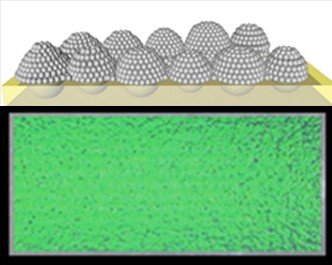
Researchers evenly coated an array of glass microspheres with smaller balls of silica. The result is a brilliantly colored, retroreflective material. The color can be adjusted by changing the size of the silica crystals, and brightness can be boosted by adding layers. At 250 nm and 40 layers deep, the crystals appeared bright green and reflected more light than commercial coatings with no color. In addition to boosting the brightness of objects for safety reasons, researchers say that by reflecting rather than absorbing light, the material could be applied to buildings to reduce the urban heat-island effect.
The authors acknowledge funding from the Ministry of Science and Technology, Republic of China.
Image caption — The structure of bug eyes (top) has inspired bright, vividly colored reflective materials (bottom). Courtesy of the American Chemical Society.