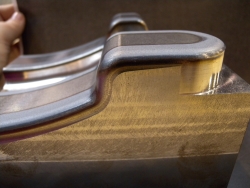
Researchers at the UPV/EHU-University of the Basque Country, Spain, say they have validated a laser scanning optics system that may enable laser hardening of steel parts of varying shape and thickness at an industrial scale. The UPV/EHU’s High Performance Manufacturing group conducted the study.
Because laser beams are highly localized, the process hardens only the selected surface, leaving the core of the part in its original state. “Therefore, the parts are not as brittle, and because little heat is inserted, the part does not become as distorted,” explains Aitzol Lamikiz, professor of the UPV/EHU’s department of Mechanical Engineering. Although laser hardening has been used since 2000, it is limited: “The laser sweeps a constant bandwidth, so the hardened zone thus ends up with a constant thickness.”
To make the technology more flexible, researchers decided to assess the viability of incorporating scanning optics into the process. Based on a galvanometric scanner, the technology involves moving a very small laser at high speed, sweeping across the surface line by line. That way, the hardening width can be adapted simply by changing the program parameters.
Prof. Lamikiz says that conventional laser hardening “would be like painting a wall with a roller, so the width that is painted corresponds to that of the roller. However, with the new technique, we replace the roller with a marker with the finest point.
“The experiments showed that it is possible to use this technique to carry out the hardening process. Then we saw how the result of the treatment changed according to the speed of the laser movement, the power used, etc. According to our tests, when the laser moves very fast, the results are similar to those of the conventional laser hardening process.”
The researchers then partnered with companies in the Basque Country and Piedmont (Italy), in a project known as Hardlas, to see how far the process was viable. “We can say that the project was a success, as we saw that it was viable, and that it could be transferred to industry.”
One of the main difficulties they came up against was controlling the process: “It is very important to get the material treated to the necessary temperature so that the hardening takes place, but it must not be exceeded, otherwise we would melt the material,” explains Prof. Lamikiz. “In our process, as the laser is constantly moving, control is more complex.” In addition, the tests were carried out at the university on lab equipment. To develop the process for an industrial scale, it would be important to try it out with more powerful lasers, different types of lasers, and on other materials.
S. Martínez, A. Lamikiz, E. Ukar, A. Calleja, J.A. Arrizubieta, L.N. Lopez de Lacalle (2016) ‘Analysis of the regimes in the scanner-based laser hardening process’. Optics and Lasers in Engineering, 90: 72–80. DOI: http://dx.doi.org/10.1016/j.optlaseng.2016.10.005
Matxalen Sotillo [email protected]