NASA, Washington, has selected proposals for the creation of two multi-disciplinary, university-led research institutes: the Institute for Ultra-Strong Composites by Computational Design (US-COMP); and the Center for the Utilization of Biological Engineering in Space (CUBES). Each STRI will receive up to $15 million over the five-year period of performance.
“NASA is establishing STRIs to research and exploit cutting-edge advances in technology with the potential for revolutionary impact on future aerospace capabilities,” says Steve Jurczyk, associate administrator for NASA’s Space Technology Mission Directorate in Washington. “These university-led, multi-disciplinary research programs promote the synthesis of science, engineering, and other disciplines to achieve specific research objectives with credible expected outcomes within five years. At the same time, these institutes will expand the U.S. talent base in areas of research and development with broader applications beyond aerospace.”
US-COMP aims to develop and deploy a carbon nanotube-based, ultra-high strength, lightweight aerospace structural material within five years. Success will mean a critical change to the design paradigm for space structures. Through collaboration with industry partners, it is anticipated that advances in laboratories could quickly translate to advances in manufacturing facilities that will yield sufficient amounts of advanced materials for use in NASA missions.
US-COMP is a multidisciplinary team of 22 faculty members led by Gregory Odegard, principal investigator at the Michigan Technological University, in partnership with Florida State University, University of Utah, Massachusetts Institute of Technology, Florida A&M University, Johns Hopkins University, Georgia Institute of Technology, University of Minnesota, Pennsylvania State University, University of Colorado and Virginia Commonwealth University. Industrial partners include Nanocomp Technologies and Solvay, with the U.S. Air Force Research Lab as a collaborator.
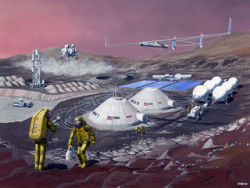
The CUBES institute will advance research into an integrated, multi-function, multi-organism bio-manufacturing system to produce fuel, materials, pharmaceuticals and food. While the research goals of the CUBES institute are to benefit deep-space planetary exploration, these goals also lend themselves to practical Earth-based applications. For example, the emphasis on using carbon dioxide as the base component for materials manufacturing has relevance to carbon dioxide management on Earth.