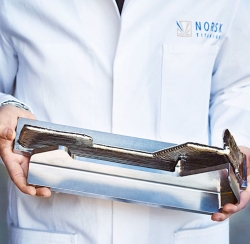
The University of Akron and Airborne Maintenance and Engineering Services, Wilmington, Ohio, announce that they have developed supersonic particle deposition, an aircraft repair method for cold spraying metal particles to rebuild the surfaces of corroded and worn parts.
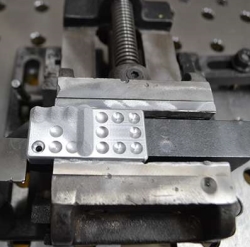
Supersonic particle deposition (SPD) is a high-pressure spraying process in which metal particles contained in a supersonic jet of an expanding gas impact a solid surface with sufficient energy to cause bonding with the surface. This additive manufacturing process builds up and repairs the surface of the metal part without creating a heat-affected zone that would result from welding or high-temperature thermal spray.
Development and testing has been underway for two years, funded by the Ohio Legislature in the last Operating Budget, and supported by the University of Akron’s National Center for Education and Research on Corrosion and Materials Performance (NCERCAMP). The collaboration includes Airborne, SAFEngineering, and U.S. Technology Corporation. The data gathered has provided the foundation with the information required for FAA approval of SPD dimensional restoration of aircraft structures.
By extending the useful life of aircraft parts, this public-private partnership initiative is anticipated to lead to the first FAA certification for full-scale commercial aircraft repair operations.
UA’s Corrosion Engineering program is the first of its kind in the United States. Housed at the University of Akron, NCERCAMP provides a multidisciplinary approach to help government and industry develop solutions for corrosion and materials performance challenges.
In response to requests from private industry and the Department of Defense in 2006, the University of Akron launched an effort to help address the cost of corrosion on the nation’s economy, estimated at more than $400 billion annually. In 2010, NCERCAMP was established by Congress and the U.S. Department of Defense.