UPV/EHU-University of the Basque Country, Spain, announces that its researchers have explored superelasticity properties on a nanometer scale based on shearing a Cu-14Al-4Ni shape-memory alloy’s pillars down to nanometric size. In an article published in Nature Nanotechnology, the researchers report that below one micron in diameter, the material behaves differently and requires much higher stress for it to be deformed. This superelastic behavior is opening up new channels in the application of microsystems involving flexible electronics and microsystems that can be implanted into the human body.
Superelasticity is a physical property by which it is possible to deform a material to a considerable extent, up to 10%, which is much higher than that of elasticity. So when stress is applied to a straight rod, the rod can form a U-shape; and when the applied stress is removed, the rod fully regains its original shape. Although this has been amply proven in macroscopic materials, “until now no one had been able to explore these superelasticity properties in micrometric and nanometric sizes,” explains José María San Juan, lead researcher and a UPV/EHU professor.
Scientists in the UPV/EHU’s Department of Condensed Matter Physics and Applied Physics II have determined that “the superelastic effect is maintained in really small devices in a copper-aluminum-nickel alloy.” It is an alloy with shape memory on which the research team has been working for over 20 years on a macroscopic level: Cu-14Al-4Ni, an alloy that displays superelasticity in ambient temperature.
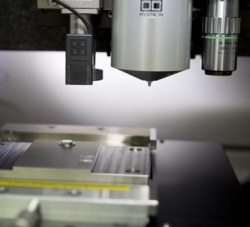
By using a focused ion beam, they built micropillars and nanopillars of this alloy with diameters ranging between 2 μm and 260 nm. The researchers then applied a stress by a nanoindenter, and measured the pillars’ behavior.
They confirmed and quantified that in diameters of less than a micrometer, there is a considerable change in the properties relating to the critical stress for superelasticity. “The material starts to behave differently and needs a much higher stress for this to take place. The alloy continues to display superelasticity, but for much higher stresses.” Prof. San Juan highlights the novelty of this increase in critical stress linked to size. “We have proposed an atomic model that allows one to understand why and how the atomic structure of these pillars changes when a stress is applied.”
The UPV/EHU professor highlighted the importance of this discovery, “spectacular superelastic behavior on a small scale,” which opens up new channels in the design of strategies for applying alloys with shape memory to develop flexible microsystems and electromechanical nanosystems. “It will be possible to build tiny micropumps or microactuators that can be implanted on a chip, and which will allow a substance to be released and regulated inside the human body for a range of medical treatments.”
Jose F. Gómez-Cortés, Maria L. Nó, Iñaki López-Ferreño, Jesús Hernández-Saz, Sergio I. Molina, Andrey Chuvilin and Jose M. San Juan. “Size effect and scaling power-law for superelasticity in shape-memory alloys at the nanoscale”. Nature Nanotechnology. May 2017. DOI: 10.1038/nnano.2017.91 http://rdcu.be/s5li