NASA, Washington, announces that a team of engineers working within its Spanwise Adaptive Wing (SAW) project is investigating the feasibility of bending or shaping portions of an aircraft’s wings in-flight, potentially increasing performance and efficiency by reducing weight and drag.
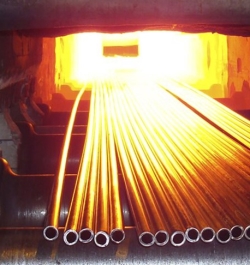
The innovative actuation system that NASA and engineers from the Boeing Company are developing is based on Nitinol shape memory alloys. The SMA materials serve as torque-tube actuators. In this configuration, a single tube or a group of trained Nitinol tubes is heated via internal heaters or external electrical coils, triggering them to twist and actuate the mechanism that drives a folding wing.
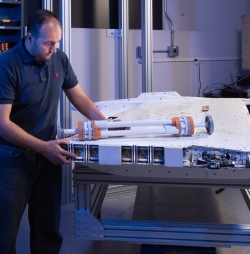
According to Dr. Othmane Benafan (shown in the photo),“By applying a temperature stimulus, you can trigger a physical change in the metal. It undergoes a reversible phase transformation, much like ice melting and refreezing, except that it transitions from one solid state to another. The changes at the atomic level are reversible, meaning that the SMA is designed to bend and then return to its original shape once heat is applied.” Dr. Benafan, vice-president of ASM International’s Shape Memory and Superelastic Technologies Society, is a materials research engineer at NASA Glenn Research Center in Cleveland, and the SAW project’s co-principal investigator.“
NASA says that the research team is developing shape-memory alloys with increased capabilities over conventional Nitinol. They are said to have higher operational loads, higher operating temperatures, and higher energy density. The material is said to have more predictable properties and can be accurately controlled, making it well-suited for aeronautics applications. It is also unique in regards to memory or “training,” because the rare microstructural features produce a better, more stable material.
https://www.nasa.gov/feature/metal-with-memory-shaping-the-future-of-aviation