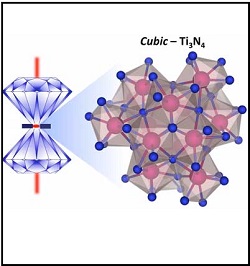
The Carnegie Institution for Science, Washington, D.C., reports that its researchers have synthesized a long-sought form of titanium nitride, Ti3N4, which has promising mechanical and optoelectronic properties.
Standard titanium nitride (TiN), with a one-to-one ratio of titanium and nitrogen, is a hard ceramic material that resists wear, and is used for tool coatings and manufacturing of electrodes. However, scientists have had difficulty producing titanium nitride with a three-to-four ratio of titanium and nitrogen, called titanic nitride.
The Carnegie team produced Ti3N4 in a cubic crystalline phase using a laser-heated diamond anvil cell, which was brought to about 740,000 times normal atmospheric pressure (74 gigapascals) and about 2200°C (4000°F). Advanced x-ray and spectroscopic tools confirmed the crystalline structure the team had created under these conditions, and theoretical model-based calculations allowed them to predict the thermodynamic nature and physical properties.
TiN is electrically conductive, but cubic Ti3N4 is a semiconductor, which means that it can have its electrical conductivity turned on and off. This possibility is tremendously useful in electronic devices. The ability to switch conductivity on and off is possible because some of a semiconductor’s electrons can move from lower-energy insulating states to higher-energy conducting states when subjected to an input of energy. The energy required to initiate this leap is called a band gap. The band gap for cubic Ti3N4 is larger than expected based on previous model predictions. Furthermore, like TiN, Ti3N4 is expected to exhibit excellent mechanical and wear-resistance properties.
“To our knowledge, this is the first experimental report on semiconducting titanium nitride,” says lead author Venkata Bhadram. “We believe that this work will stimulate further experimental and theoretical efforts to design new ways to scale up the synthesis of Ti3N4 at ambient pressure.”
The team of experimental and computational scientists was led by Carnegie Institute’s Tim Strobel and Venkata Bhadram. Members included Carnegie’s Hanyu Liu , and Rostislav Hrubiak; Vitali B. Prakapenka of the University of Chicago; Enshi Xu and Tianshu Li of George Washington University; and Stephan Lany of the National Renewable Energy Laboratory.
Their work is published and highlighted as an Editor’s Suggestion in Physical Review Materials (“Semiconducting cubic titanium nitride in the Th3P4 structure”).