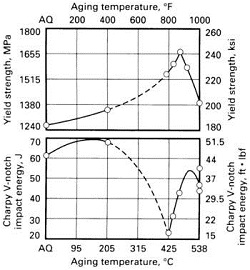
The graph shows the effect of aging temperature on impact energy (bottom) and yield strength (top) of AF 1410 steel (VIM/VAR plate ⅝ in. thick). Heat treatments: Heat at 1650°F for half an hour and water quench; heat at 1500°F for half an hour and water quench; age for five hours at indicated temperatures and air cool. (AQ = as-quenched).
In the late 1970s, the U.S. Air Force sponsored development work for improved submarine hull steels. From this work, AF 1410 evolved as an ultrahigh-strength steel with particularly high fracture toughness. AF 1410 is typically manufactured via vacuum induction melting (VIM) followed by vacuum arc remelting (VAR) to achieve the required low levels of impurities.
For improved or finer grain size, producers often recommend forging reductions of 40% below 1650°F. This grade is typically supplied in normalized and overaged condition for best machinability. The steel is then renormalized and austenitized or double austenitized, air cooled/quenched, cooled to –100 °F, and aged to attain maximum properties.
The microstructure of AF 1410 consists of iron-nickel lath martensite with carbides from age precipitation for strengthening. Quenching from the austenitizing temperature produces a highly dislocated lath martensite that has a high toughness, as measured by the Charpy V-notch impact test.
Aging produces a complex series of changes in carbide structure. At approximately 800°F, iron carbide Fe3C is precipitated. At 850°F, the Fe-Cr-Mo M2C carbide is obtained, which at 900°F begins to produce a pure molybdenum-chromium M2C carbide. By raising the temperature to 950°F, the M2C will begin to coarsen; at 1000 °F, M2C will begin to be replaced by M6C, which has little strengthening effect.
The secondary hardening, which is due to the aging, produces a maximum tensile strength when aged at 900°F for five hours. It has minimum impact energy when aged at 800°F, as shown in the graph.
When aged in the temperature range between 800 and 1000°F, the impact energy exhibits a maximum at approximately 947°F. At aging temperatures above 1000°F, both the tensile strength and the impact energy decrease rather rapidly.