Maraging steels are made of highly alloyed low-carbon iron-nickel martensite. These steels possess an excellent combination of strength and toughness that is superior to that of most carbon-hardened steels. As such, they constitute an alternative to hardened carbon steels in critical applications where high strength and good toughness and ductility are required.
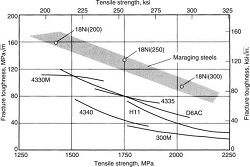
The graph shows the strength/toughness combination of 18Ni maraging steels compared to conventional high-strength carbon steels.
Hardened carbon steels derive their strength from transformation-hardening mechanisms (such as martensite and bainite formation) and the subsequent precipitation of carbides during tempering. In contrast, maraging steels derive their strength from the formation of a very low-carbon, tough, and ductile iron-nickel martensite, which can be further strengthened by subsequent precipitation of intermetallic compounds during age hardening.
The term marage was coined based on the age hardening of the martensitic structure. Age hardening of martensite, or maraging, depends on the occurrence of a thermal hysteresis of phase transformations, whereby the reversion of martensite to austenite during reheating occurs at a higher temperature range than the temperature range for martensite formation during cooling. During the aging of the martensitic structure, the basic objective is to form a uniform distribution of fine intermetallic precipitates, which serve to strengthen the martensitic matrix.
This information is from Volume 4D, Heat Treating of Irons and Steels -> Heat Treated High Alloy Steels -> Heat Treating of Maraging Steels.