Defense TechLink, Bozeman, Montana, reports that the U.S. Air Force Research Laboratory at Eglin AFB in Florida has developed USAF-96 Steel, a low-alloy steel that has demonstrated strength and toughness at −40°C even in sections up to four inches thick. When thermally processed by a specific method, the steel provides these typical values: ultimate tensile strength of 245 ksi; yield strength at 0.2% offset of 187 ksi; elongation to failure of 13%; and impact toughness of 30 ft-lb as measured with a Charpy V-notch test at −40°C.
Steels with this combination of performance usually contain significant amounts of tungsten, cobalt, and/or nickel, which are among the most expensive alloying elements. Moreover, tungsten is difficult to process and complicates the waste streams. In addition, most high-performance Ni-Co alloys require expensive vacuum-induction-melting/vacuum-air-remelting techniques.
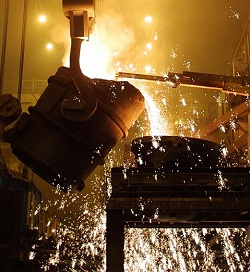
USAF-96 Steel contains no tungsten or cobalt, and low amounts of carbon and nickel. In addition to its material cost advantage, USAF-96 Steel can be produced by standard “air-melt” production processes, at a substantially lower cost than prior methods.
Its composition, along with specific thermal processing conditions, lead to the growth of beneficial nano-scale carbides in a martensitic matrix. This allows USAF-96 Steel to maintain its high-performance characteristics even in heavier sections, while using reduced quantities of expensive alloying elements.
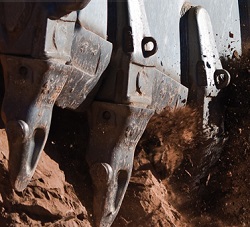
The lab has scaled up production to 200,000 pounds. Applications may include penetrators, ground-engaging tools, and oil and gas applications. It is compatible with air-melt production, e.g., vacuum-degassed open ladle and argon-oxygen decarburization. It is also amenable to sand/investment casting followed by hot isostatic pressing and forging processes.
https://techlinkcenter.org/technologies/low-alloy-high-impact-toughness-steel/