Great effort has been devoted to examining the properties of overaged maraging steels. The general belief is that an overaged microstructure should have good resistance to both fracture and stress-corrosion cracking as a result of the inherent lower strength and the potential crack-blunting ability of finely distributed austenite particles.
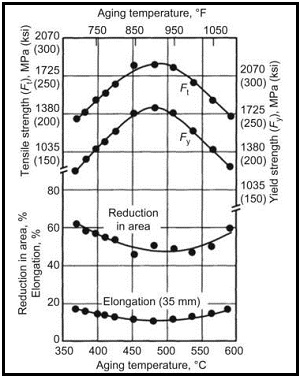
In many instances, this has been found to be so, and impressive improvements in plane-strain fracture toughness (KIc) or threshold stress intensity for stress-corrosion cracking (KIscc) have been achieved with only modest reductions in yield strength of an overaged structure, as shown in the graph. Unfortunately, however, there appears to be more heat-to-heat variability when overaging heat treatments are used. This variability is the result of a greater sensitivity of austenite formation to minor changes in composition and processing. Even the most homogeneous-looking structures contain minor alloy segregation that is manifested in the form of alloy-rich and alloy-lean bands. The alloy-rich bands tend to overage more rapidly than their alloy-lean counterparts. It is therefore difficult to recommend specific overaging heat treatments that will produce consistent mechanical properties.
Generally, if a specific yield strength is required, it is better to use a maraging steel in which the required strength can be produced by conventional aging, than to use an overaged steel of higher strength.
Volume 4D, Heat Treating of Irons and Steels -> Heat Treated High-Alloy Steels ->Heat Treating of Maraging Steels -> Age Hardening