Virginia Polytechnic Institute and State University (Virginia Tech), Blacksburg, and Lawrence Livermore National Laboratory, Calif., announce that their researchers have developed a novel way to 3D print complex objects of graphene, the form of carbon that is one of the world’s strongest materials.
Previously, researchers could only print graphene in thin flat sheets or basic structures, down to 100 microns, but the new technique allows printing down to 10 microns in resolution. This theoretically unlocks the ability to 3D print any size or shape of structure in graphene. 3D printed graphene products would be highly useful in many industries, including batteries, aerospace, separation, heat management, sensors, and catalysis.
To make 3D graphene structures, the researchers start with graphene oxide, a precursor to graphene, crosslinking the sheets to form a porous hydrogel. Breaking the graphene oxide hydrogel with ultrasound and adding light-sensitive acrylate polymers, they use projection micro-stereolithography to create the solid 3D structure with the graphene oxide trapped in the long, rigid chains of acrylate polymer. Finally, they place the 3D structure in a furnace to burn off the polymers and fuse the object together, leaving behind a pure and lightweight graphene aerogel.
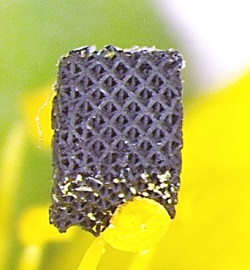
The photo shows a graphene octet truss on a strawberry blossom.