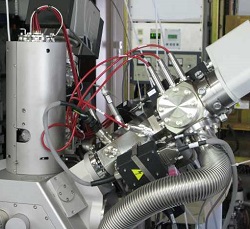
Tescan USA, Warrendale, Pa., introduces the S9000X, its latest flagship Xe plasma FIB-SEM, which provides precise, damage-free large area cross-sectioning coupled with a high throughput rate, up to 50 times faster than conventional gallium FIBs. Furthermore, the Xe helps to overcome some of the drawbacks of gallium, including amorphization that can lead to incorrect analyses.
Another key benefit of the new iFIB+ Xe plasma FIB column is that it offers an unparalleled field of view, resulting in the ability to carry out large area cross sectioning as well as offering the highest levels of automation. This will assist users by reducing the bottlenecks in TEM sample preparation and accelerating 3D materials characterization.
The new iFIB+ column is coupled with the Tescan next-generation TriGlav ultra-high resolution SEM. The three-objective lens system in the TriGlav column significantly reduces aberration allowing you to achieve sub-nanometer resolution (0.7 nm) while keeping the extremely high current (400 nA). It also enables field-free imaging of magnetic samples and live monitoring of FIB operations. Energy-filtered axial BSE signal collection also provides enhanced surface sensitivity, while adaptive spot shape optimization results in better contrast at all beam currents for ultimate imaging.
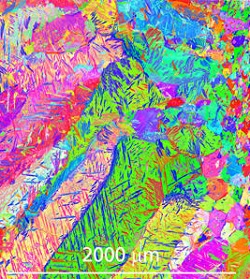
The S9000X is also the perfect choice for 3D materials characterization. With its specifically designed chamber geometry, it can easily incorporate multiple detectors, including EDS, EBSD, CL, X-ray source, and ToF-SIMS. ToF-SIMS can also be fully integrated and offers isotope identification as well as light element (down to Hydrogen) detection, with Xe enhancing the already excellent detection limits (better than 5 ppm). In all cases the rapid rates of material removal lend this system to being an excellent system for 3D materials analysis including tomography.