Researchers at the Massachusetts Institute of Technology, Cambridge, and Sandia National Laboratories, Albuquerque, N.M., announce that they have developed, tested, and made available a laser-based system that can continuously monitor radiation-induced changes in nuclear reactor materials of construction.
With many nuclear plants nearing the end of their operational lifetimes under current regulations, knowing the condition of materials inside them can be critical to understanding whether their operation can be safely extended, and if so by how much.
The new laser-based system can be used to observe changes to the physical properties of the materials, such as their elasticity and thermal diffusivity, without destroying or altering them, the researchers say. The findings are described in the journal Nuclear Instruments and Methods in Physics Research Section B in a paper by MIT doctoral student Cody A. Dennett, professor of nuclear science and engineering Michael P. Short, and by Sandia researchers Daniel L. Buller and Khalid Hatter.
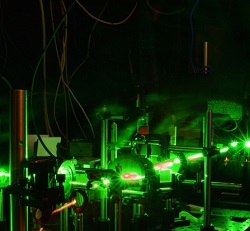
The new system, called transient grating spectroscopy, is based on laser beams that probe minute changes at a material’s surface that can reveal details about changes in the structure of the interior. Two years ago, Dr. Dennett and Dr. Short adapted the approach to monitor radiation effects. Now, after extensive testing, the system is ready for use by researchers exploring the development of new materials for next-generation reactors, or those looking to extend the lives of existing reactors through a better understanding how materials degrade over time under the harsh radiation environment inside reactor vessels.