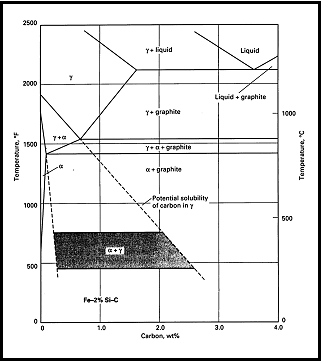
The usual objective of austenitizing is to produce an austenitic matrix with as uniform a carbon content as possible prior to thermal processing. The graph shows the 2% silicon section of the Fe-C-Si phase diagram.
For a typical hypereutectic ductile cast iron, an upper critical temperature must be exceeded so that the austenitizing temperature is in the two-phase (austenite and graphite) field. This temperature varies with alloy content. Equations to predict the location of the upper critical temperature with varying chemical compositions are found in the literature.
It also is clear from the graph that the “equilibrium” austenite carbon content in equilibrium with graphite increases with an increase in austenitizing temperature. This ability to select (within limits) the matrix austenite carbon content makes austenitizing temperature control important in processes that depend on carbon in the matrix to drive a reaction. This is true particularly in structures to be austempered, in which the hardenability (or austemperability) depends to a significant degree on matrix carbon content.