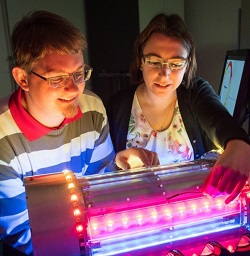
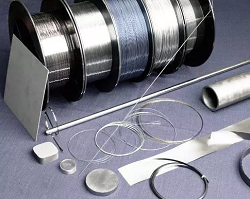
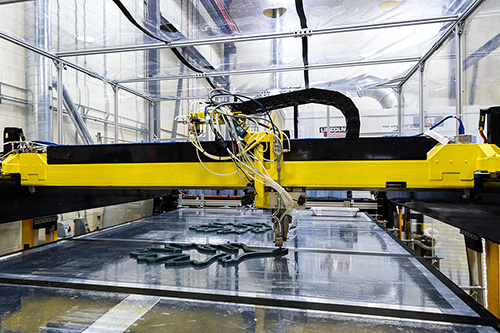
Saarland University, Germany, reports that a team of its researchers has prototyped a heating/cooling system that first stresses and then releases Nitinol wires to create heated and cooled air at twice the efficiency of a heat pump. The device is based on the fact that Nitinol wires absorb significant amounts of heat when bent out of shape, and then they release that heat when allowed to revert to normal shape. The temperature difference between the loaded wire and the released wire can be as much as 20°C (36°F).
The cooling device is thus quite simple in concept. It consists of a rotating cylinder covered with Nitinol wire bundles. The wires are bent as they pass through one side, sucking heat out of the air and storing it. Then as they rotate past the other side, they snap back into shape, dumping the heat on the second side. Air is blown through chambers on each side, enabling one feed of heated air and another feed of cool air.
The Saarland University team has been experimenting with the device to determine the optimal convergence of wire loading, rotational speed, and number of wires per bundle to create the biggest possible heat differential between the two sides from a given energy input.
Researchers claim that “the heating or cooling power of the system is up to thirty times greater than the mechanical power required to load and unload the alloy wire bundles,” depending on the specific alloy. They say that this makes the new system more than twice as good as a conventional heat pump, and three times as good as a conventional refrigerator.