Scientists at Pacific Northwest National Laboratory (PNNL) have focused for years on creating a 3D map of the atomic activities happening on an iron surface. Recently, using a rare imaging technique—atom probe tomography—they were finally able to map atomic exchanges between goethite, a major component of rust, and iron from its surrounding solution.
The PNNL scientists have visualized mineral iron’s reactivity when deprived of oxygen, such as below the soil surface. Using tracer ions, they followed the chemical reactions to create 3D “atomic maps.”
The maps show the rearrangement of iron atoms on a surface. In analyzing the maps, researchers revealed a dynamic iron cycle. Iron continually moves on and off mineral surfaces, seeking defects and going deeper into the crystals (PNAS, “Visualizing the iron atom exchange front in the Fe(II)-catalyzed recrystallization of goethite by atom probe tomography”).
The results confirm that reactions with iron in soils and steel corrosion products are more dynamic than typically thought. The study illustrates how rust persists on metal pipes under changing chemical conditions, enabling it to continually corrode and deteriorate over time.
Both underneath our feet and in the skyscrapers towering above, iron is constantly reacting. In the soil, these reactions can affect both nutrient and heavy metal availability. In buildings and bridges, these reactions lead to rust. The exact nature of the reactions was not well understood, in part because of the challenges of imaging the atomic-scale interactions that happen on iron surfaces.
The results let the team determine how far tracer atoms, tracked by atom probe tomography, dug into the surface, a key part of corrosion reactions. In just the earliest stages, the atoms had dug in about 3.5 nanometers, far deeper than previously thought.
They also found these atoms concentrated in hot spots where defects resided. The team’s results offer insights into a broad range of processes, from the formation of rust to decontamination of soil where goethite can bind heavy metals.
************
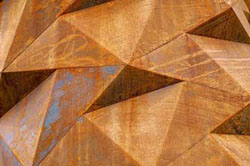
Image – Researchers created a 3D atomic map that offers a highly detailed view of how rust (shown here) forms. Courtesy of Piabay.
For more information: