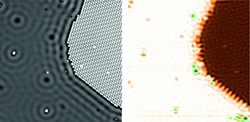
A new method for measuring the electric potential fields in a sample of atoms was discovered by a team of researchers from Forschungszentrum Jülich along with the University of Magdeburg. Conventional methods have been unable to quantitatively record the electronic potential of individual atoms in the immediate vicinity. The new quantum dot microscopy method could open up new opportunities for chip manufacturers and other industries.
The positive atomic nuclei and negative electrons of which all matter consists produce electric potential fields that superpose and compensate each other, even over very short distances. Almost all established methods capable of imaging such potentials are based on the measurement of forces that are caused by electric charges. Yet these forces are difficult to distinguish from other forces that occur on the nanoscale, which prevents quantitative measurements.
Four years ago, however, scientists from Forschungszentrum Jülich discovered a method based on a completely different principle. Scanning quantum dot microscopy involves attaching a single organic molecule—the “quantum dot”—to the tip of an atomic force microscope. This molecule then serves as a probe. “The molecule is so small that we can attach individual electrons from the tip of the atomic force microscope to the molecule in a controlled manner,” explains Dr. Christian Wagner, head of the Controlled Mechanical Manipulation of Molecules group at Jülich’s Peter Grünberg Institute.
The researchers immediately recognized how promising the method was and filed a patent application. However, practical application was still a long way off. “Initially, it was simply a surprising effect that was limited in its applicability. That has all changed now. Not only can we visualize the electric fields of individual atoms and molecules, we can also quantify them precisely,” explains Wagner. “This was confirmed by a comparison with theoretical calculations conducted by our collaborators from Luxembourg. In addition, we can image large areas of a sample and thus show a variety of nanostructures at once. And we only need one hour for a detailed image.”
The Jülich researchers spent years investigating the method and finally developed a coherent theory. The reason for the very sharp images is an effect that permits the microscope tip to remain at a relatively large distance from the sample, roughly 2–3 nanometers—unimaginable for a normal atomic force microscope.
The Jülich researchers owe the speed at which the complete sample surface can be measured to their partners from Otto von Guericke University Magdeburg. Engineers there developed a controller that helped to automate the complex, repeated sequence of scanning the sample. “With the Magdeburg engineers’ controller, we can now simply scan the whole surface, just like using a normal atomic force microscope. While it used to take us 5–6 hours for a single molecule, we can now image sample areas with hundreds of molecules in just one hour,” says Wagner.
There are some disadvantages as well, however. Preparing the measurements takes a lot of time and effort. The molecule serving as the quantum dot for the measurement has to be attached to the tip beforehand—and this is only possible in a vacuum at low temperatures. In contrast, normal atomic force microscopes also work at room temperature, with no need for a vacuum or complicated preparations.
There are many fields of application for quantum dot microscopy. Semiconductor electronics is pushing scale boundaries in areas where a single atom can make a difference for functionality. Electrostatic interaction also plays an important role in other functional materials, such as catalysts. The characterization of biomolecules is another avenue.
************
Image – Image from a scanning tunneling microscope (left) and a scanning quantum dot microscope (right). Courtesy of Forschungszentrum Jülich/Christian Wagner.
For more information: