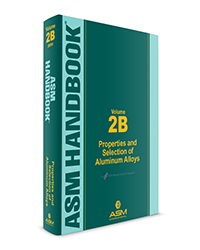
 Three additional handbook articles from ASM Handbook, Volume 2B: Properties and Selection of Aluminum Alloys have been published digital-first in ASM Handbooks Online™ in the ASM Digital Library in advance of the full volume release. The full volume, edited by Kevin Anderson, John Weritz, and J. Gilbert Kaufman, is scheduled to be released online and in print later this month.
These articles are now available digital-first in ASM Handbooks Online™:
Fracture Resistance of Aluminum Alloys[1] NEW!
By J. Gilbert Kaufman. This article discusses the concepts underlying linear elastic fracture mechanics and elastic-plastic fracture mechanics as well as their importance in characterizing the fracture behavior of the high-strength aluminum alloys. It describes the three methods used for analyzing elastic-plastic fracture, namely R-curve concept, J-integral concept, and crack tip opening displacement method. The article considers the primary measures used to assess the toughness of aluminum alloy castings and wrought alloys: notch toughness, tear resistance, and plane-strain fracture toughness.
Fatigue of Aluminum Alloys[2] NEW!
By J. Gilbert Kaufman. This article describes the effects of cyclic fatigue properties on aluminum alloys. It provides a discussion on strain-control fatigue and the effects of two microstructural features on the strain life of aluminum alloys: shearable precipitates and precipitate-free zones. The article discusses various models of fatigue crack growth (FCG) and the effects of alloy microstructure and composition on FCG.
Properties and Applications of Wrought Aluminum Alloys NEW!
By J. Gilbert Kaufman. This article summarizes the characteristics, material properties, and typical applications of aluminum alloy wrought products. It describes the most widely used worldwide alloy designation system and discusses five major categories, namely flat-rolled products; rod, bar, and wire; tubular products; shapes; and forgings. The article also discusses three widely used indexes to define the fracture resistance of aluminum alloys: notch toughness, tear resistance, and plane-strain fracture toughness. It also describes three types of corrosion attack of these alloys: general or atmospheric surface corrosion, stress-corrosion cracking, and exfoliation attack.
Missed the first release of the digital-first articles? Click here for more information.
[1] Adapted from R.J. Bucci, G. Nordmark, and E.A. Starke, “Selecting Aluminum Alloys to Resist Failure by Fracture Mechanisms,” Fatigue and Fracture, Volume 19, ASM Handbook, ASM International, 1996, p 771–812, and from J.D. Landes, W.T. Becker, R.S. Shipley, and J. Raphael, “Stress Analysis and Fracture Mechanics,” Failure Analysis and Prevention, Volume 11, ASM Handbook, ASM International, 2002, p 460–483
[2] Adapted from R.J. Bucci, G. Nordmark, and E.A. Starke, “Selecting Aluminum Alloys to Resist Failure by Fracture Mechanisms,” Fatigue and Fracture, Volume 19, ASM Handbook, ASM International, 1996, p 771–812
About the ASM Digital Library
ASM International serves the materials research, reference, and education needs of engineers and scientists over the course of their careers through its comprehensive and authoritative information resources. The ASM Digital Library provides discoverable, convenient, and interactive access to articles, books, databases, and industry news on current engineering practices and scientific research in the development, manufacturing, testing, modeling, and application of engineered materials.
ASM Handbooks Online™ and the ASM Failure Analysis Database™ are the first resources presented in the new ASM Digital Library platform. Over time, other materials information resources published by ASM International will be integrated into the platform. In the meantime, convenient links to these resources are provided on the ASM Digital Library homepage and on the persistent site footer.
Experts on materials engineering topics are encouraged to volunteer to update or contribute new content to the ASM Digital Library. Please contact [email protected] to volunteer. Other comments and questions can be sent to the same email address.
For information on subscription access to the ASM Digital Library, contact the Online Database Manager at 440.338.5151 or via email at [email protected].