To overcome the limitations on product cross-sectional thickness and the risk of slack quenches, alloy modifications have been introduced over the years to the base 52100 chemical composition. The modifications constitute a group of high hardenability 52100 steels.
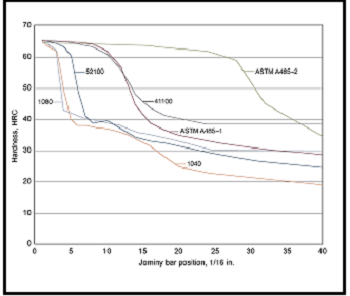
Specifically, ASTM A485 contains four distinct 52100-type steels with increased hardenability mainly due to higher manganese and molybdenum additions. Figure 9 shows the results of computer modeling of Jominy tests to illustrate hardenability differences between ASTM A295 (52100) air-melted bearing steels, and ASTM A485 high-hardenability bearing steels. The increase in hardenability is significant and makes the use of through-hardening bearing steels viable in large ring-thickness bearing projects and in applications requiring quench pressing for distortion control of bearing rings.
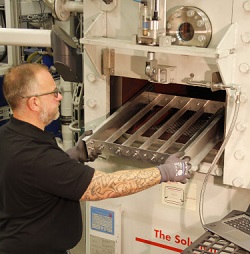
The recommended heat treatment for high hardenability bearing steels is:
Austenitize 815–830 °C (1500–1525 °F) 30–60 min + 30 min for each additional inch of thickness, endo or neutral atm with 0.9–1 C potential;
Quench ≤150 °C (300 °F) agitated oil (martensitic hardening); ≥230 °C (445 °F) molten salt (bainitic hardening);
Temper 220–245 °C (430–475 °F) 4 h (58–62 HRC).
For more information, click on the link below (subscription required), then scroll down the Chapter Contents on the left of the page, and click on High-Hardenability Steels in the 52100 Family.
https://dl.asminternational.org/handbooks/book/9/chapter/110017/Heat-Treatment-of-Bearings