Through-hardening bearing steels from the ASTM A295 and A485 families that are given a typical heat treatment, operate well up to the 120–135 °C (250–275 °F) service range. Other through-hardening bearing steels have been developed over the years for use in specialty applications in higher temperature service or in atmospheric corrosive environments.
Some of these steels and service environments in which they operate:
Tool steels
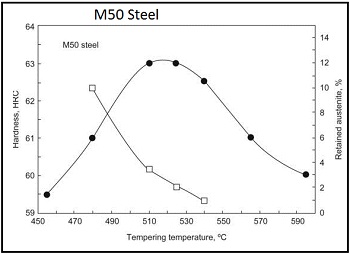
M50 (jet engines, other aerospace applications up to 430 °C (800 °F)
M62 (high temperature, high stress applications)
T5 and T15 (high temperature, high stress applications)
Corrosion–resistant steels
Cronidur 30 (high temperature, corrosive applications)
BG42 (high temperature, corrosive applications; stable to 430 °C, or 900 °F)
XD15NW (high temperature, corrosive applications)
Type 440C (ambient temperature atmospheric corrosion)
440 N-DUR (ambient temperature atmospheric corrosion)
These special purpose steels were modified and tailored for their respective service environments. Because several of them are used in aerospace applications, they are also subject to specialized melting practices, such as consumable electrode vacuum melting (CEVM) and vacuum induction melted-vacuum arc remelting (VIM-VAR), which provide very low-inclusion content microstructures.
These high cleanliness specialty steels must be heat treated with care as they still are subject to the previously described restrictions of air-melted through-hardening steels, and certain precautions must be taken during high hot-working temperatures and heat treating.
For more information, click on the link below (subscription required), then scroll down the Chapter Contents column on the left of the page, and click on “Special Purpose Through-Hardening Bearing Steels.”
https://dl.asminternational.org/handbooks/book/9/chapter/110017/Heat-Treatment-of-Bearings