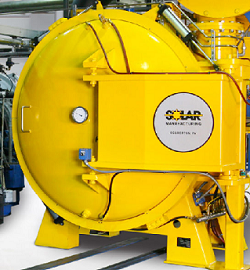
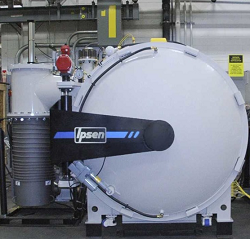
Engineers from Solar Atmospheres, Souderton, Pa., will present a discussion at Heat Treat 2019 about the use of nitrogen rather than hydrogen as the diluting gas during ammonia gas nitriding for safety, economic, and environmental reasons. They recently carried out gas nitriding studies that showed different white layer phase ratios on pure iron powders than the Lehrer diagram indicates. The widely published Lehrer phase diagram for ammonia/hydrogen gas nitriding of pure iron has been used as a reference guide for selecting ammonia/nitrogen mixtures for nitriding of alloy steels, though the diagram is not precise or accurate when the diluting gas is not hydrogen.
Recent R&D gas nitriding studies on pure iron powders indicate that the use of nitrogen as the diluting gas produces considerably different compound layer (white layer) phase ratios compared to the standard Lehrer ammonia/hydrogen mixtures, according to XRD analysis. Current data reveals that nitrogen shifts the Lehrer diagram phase boundaries to the left. This is pertinent to the topic, as only the gamma prime phase (Fe4N) is desired, not epsilon (Fe2-3N). Literature indicates that Fe4N has uniquely sought-after magnetic properties in some specialized industries. Testing currently is being performed to compare the pure iron results to that obtained when nitriding common low-alloy, medium-carbon steel.
Presentation title: “The Influence of Nitrogen versus Hydrogen Diluting Gas on the Compound Layer Phase Formation during Ammonia Gas Nitriding of Iron and Low Alloy Steels.”
Authors: Dr. Virginia Osterman, Mr. Donald Jordan, Solar Atmospheres, Souderton, Pa.
Tuesday, October 15, 2019: 9:40 AM, 251A (TCF Center), Detroit