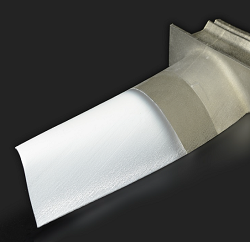
Engineers from the Fraunhofer Institute for Material and Beam Technology IWS Dresden, Germany, report that they have developed a new ceramic heat shield technology in which a powder of yttrium-stabilized zirconium oxide (YSZ) is added to water to form a suspension. This liquid-powder mixture can be sprayed quickly and cost-effectively onto turbine blades or other aircraft parts. Similar thermal barrier coatings (TBCs) applied to aircraft engine components enable reduced fuel consumption.
With the “YSZ suspension spraying,” the IWS researchers have developed an alternative process to use a very fine ceramic powder made of yttrium-stabilized zirconium oxide. The grains in this powder have a diameter of only one micrometer or even smaller.
The engineers mix a suspension with water or alcohol. In this way, the particles can be sprayed. The result is a shielding layer that is about 500 micrometers thick. Since no vacuum is required here, the costs remain rather low. Also, large aircraft components can be coated at relatively high speeds.
A coated aircraft turbine can operate at higher temperatures than an uncoated aggregate. For example, the solution developed by Fraunhofer IWS could raise the operating temperature of a turbine by around 150 Celsius degrees at comparatively low cost. As a result, it increases efficiency, extends its service life, and reduces cooling costs. The bottom line is lower fuel consumption.
The IWS process is also attracting great interest in the semiconductor industry. For instance in chip production, the large microelectronics factories use plasma etching chambers. In these chambers, aggressive fluorine compounds repeatedly destroy the chamber walls. Together with small and medium-sized companies, IWS engineers are working on an IGF project to make ceramics such as tungsten carbide sprayable in a cobalt matrix.