Higher hardening temperatures are required for products machined from small bar sizes that have been annealed various times during thermomechanical processing. Secondary carbides become larger and more stable and are more difficult to dissolve during austenitizing. Either a higher austenitizing temperature or longer soak times at lower temperatures, or both, is required to dissolve adequate carbon in solution to achieve a minimum hardness of 58 HRC.
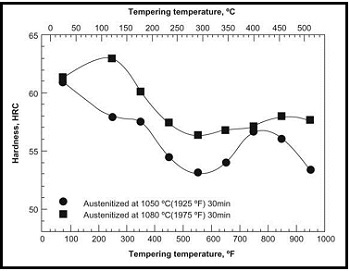
Figure 19 shows the effect of austenitizing temperature and tempering temperature on the hardness of 440 N-DUR. To achieve maximum corrosion resistance in 440 N-DUR, it should be tempered at lower temperatures, avoiding tempering near the secondary-hardening temperatures. Very rapid quenching (oil or gas) is necessary to avoid grain boundary precipitation of chromium carbides, which also has an adverse effect on corrosion resistance. BG-42 typically is used in high-temperature applications where hot hardness (high-temperature hardness) and corrosion resistance are required.
For more information, click on the link below (subscription required), then scroll down the Chapter Contents column on the left of the page, and click on “Special Purpose Through-Hardening Bearing Steels.”
https://dl.asminternational.org/handbooks/book/9/chapter/110017/Heat-Treatment-of-Bearings