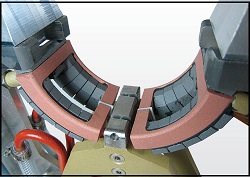
Engineers from Fluxtrol Inc., Auburn Hill, Mich., reported on a study at Heat Treat 2019 in which they used computer models to show the various sources of magnetic flux in an inductive welding system. Inductive welding is a popular method for making tubes for a variety of industries. However, demand is growing for heavy-walled, small-diameter tubing and AHSS tubing, both of which require lower frequencies and higher magnetic flux densities to maintain weld quality.
The ferrite tubes traditionally used in these systems have low saturation flux density, which places limitations on these heavy-walled systems. This new situation creates an opportunity to improve the system performance by using soft magnetic composite materials with higher saturation flux densities.
In this study, computer models were used to show the various sources of magnetic flux in the system. We compared impeders designed using soft magnetic composites, and traditional ferrite impeders for use in challenging tube welding applications.
New high-magnetic-field, high-frequency-loss data was used in coupled models, showing that with proper thermal management, the soft magnetic composite materials can operate reliably under these conditions and lead to improved tube welding system performance.
Title: “Improving Inductive Welding System Performance with Soft Magnetic Composites”
Authors: Sean M. Muyskens, Tareq I. Eddir, Robert C. Goldstein, Fluxtrol Inc.