Engineers from Höganäs AB, Sweden, reported at the ITSC conference last May that laser cladding has been practiced for about 40 years, but did not reach a level of general acceptance in the industry until recently, because other coating processes, such as PTA, thermal spray, and GMAW, are well known and have a lower investment cost than lasers.
However, the benefits of laser cladding include lower heat input, lower dilution, less material consumption, and overall better performance. With the recent development of high-power laser sources from 10 µm wavelength CO2 lasers to high-power solid-state lasers with wavelengths around 1 µm, improved process efficiency, lower costs, and smaller footprints are achieved. As a result, laser cladding has rapidly become more interesting for a wide variety of applications.
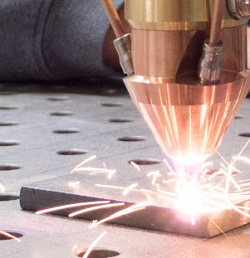
The most novel development in surface coating is high-speed laser cladding with surface speeds up to 400 m/min, depending on properties of the powder and substrate. The high process speed, low heat input, and minimal dilution with the substrate open up possible new applications and material combinations previously not possible with conventional laser cladding.
This paper showed some of the successful applications and material combinations the authors have achieved with high-speed laser cladding.
Title: High-Speed Laser Cladding for Innovative Applications
Authors: Dr. Conny M Lampa, Mr. Ivan Smirnov, Mrs. Ingrid Hauer Miller, Höganäs AB, Höganäs, Sweden
www.asminternational.org/web/itsc-2019/home