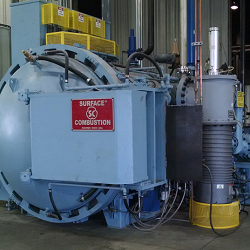
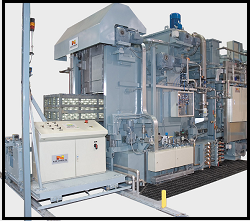
Surface Combustion Inc., Maumee, Ohio, has developed Power Convection vacuum furnaces, in which the cylindrical inner chamber includes graphite heating elements that uniformly radiate to each other, providing a wall of heat. This gives the workload a very uniform band of heating through the operating temperature range, which is typically from 1400 to 2400°F.
The workload is heated under a vacuum, the level of which is determined by the pumping system selected. For vacuum levels down to ten microns, a combination mechanical piston pump with a blower is used. If higher vacuum levels are required, a diffusion pumping system operating in conjunction with the base pumping systems would be used. The inner chamber is typically graphite-based rigid board and/or felt with machined graphite resistance heating elements. All are mounted within a stainless steel inner chamber frame, which allows for multiple rebuilds within the same frame. The heating elements are powered with a low voltage, high current variable reactance transformer.
After the thermal heating cycle, the furnace is backfilled with inert gas, from a vacuum to a positive pressure of 2 or 6 bar. Once backfilled, a high-capacity and high-convection fan recirculates this hot inert gas through internal cooling coils (heat exchangers) to rapidly cool the load. The access door is hydraulically clamped in place with a locking ring assembly. The goal in vacuum processing is to cool the workload back down to ambient temperature to avoid workload discoloration and oxidation.
The Power Convection vacuum furnace is best suited for higher temperature processing where radiant heat is the dominant heat transfer mechanism. The best applications are those over 1400°F. This is the transition point of the effectiveness of radiant heating versus convection heating. Typical processes include hardening, annealing, sintering and brazing.