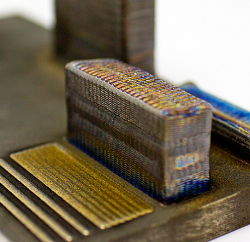
The Australian Royal Melbourne Institute of Technology (RMIT), the Commonwealth Scientific and Industrial Research Organisation (CSIRO), the University of Queensland, and Ohio State University have collaborated in a project to develop a titanium-copper alloy that can be additively manufactured without generating columns that weaken the final product.
Current titanium alloys for additive manufacturing often cool and bond together in column-shaped crystals during the 3D printing process, making them susceptible to cracking or distortion. Unlike aluminum or other metals, no commercial grain refiner is available for titanium that manufacturers can use to effectively refine the microstructure to avoid these issues.
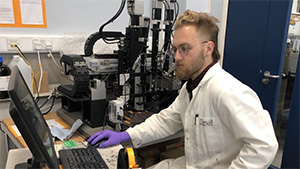
Professor Mark Easton from RMIT University’s School of Engineering says the new titanium-copper alloy printed with “exceptional properties” without any special process control or additional treatment.
“Of particular note was its fully equiaxed grain structure,” says Prof. Easton. “This means the crystal grains had grown equally in all directions to form a strong bond, instead of in columns, which can lead to weak points liable to cracking. Alloys with this microstructure can withstand much higher forces and will be much less likely to have defects, such as cracking or distortion, during manufacture.”
https://www.rmit.edu.au/news/all-news/2019/dec/3dprinting-titanium-copper