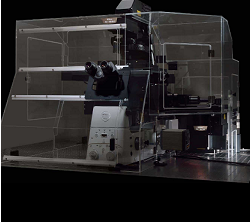
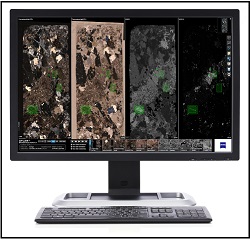
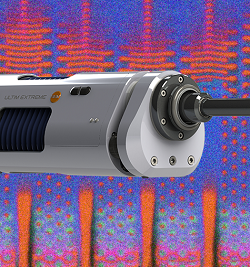
Nikon Instruments, Melville, N.Y., describes super-resolution structured illumination microscopy (SIM) as a revolutionary imaging technique for doubling the resolution of a widefield microscope in 3D. It is a user-friendly super-resolution technology easily applied to a variety of sample types.
Structured illumination is performed with beam interference at the sample plane, producing a diffraction-limited and sinusoidal pattern of light-dark stripes. The single spatial frequency present in the pattern mixes with the various spatial frequencies comprising the sample structure. In short, spatial frequencies usually outside of the microscope bandpass may be artificially down-modulated via frequency mixing, allowing for their indirect detection and subsequent restoration in post-processing. SIM may provide up to a 2x improvement over the optical resolution of a typical widefield microscope in x, y, and z.
Nikon’s new N-SIM S system uses a spatial light modulator (SLM) for pattern generation, unlocking acquisition rates of up to 15 frames per second. The increase in acquisition rate is especially useful for live cell imaging, but also shortens the time required for acquiring z-stacks and other dimensions. The N-SIM S is capable of simultaneous or sequential multicolor imaging, 3D-SIM, 2D-SIM, and 2D TIRF SIM with a variety of objectives and immersion types.
The N-SIM E system is a value implementation of the original N-SIM system, providing 3D-SIM imaging with 3 laser wavelengths using a single diffraction grating.
https://www.microscope.healthcare.nikon.com/learn/focus-on/super-resolution