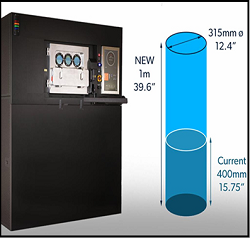
Digital manufacturer Velo3D, Campbell, Calif., announces plans to launch a next-generation Sapphire industrial 3D metal printer with a vertical axis of one meter. The system will ship in Q4 2020, with precision-tool and component manufacturer Knust-Godwin securing the first order, to produce parts for an oil and gas application.
“Our vision at Velo3D is to enable end users to build whatever they want without the constraints of yesterday’s standards,” states Benny Buller, Founder and CEO. “One of those constraints is the build envelope. A meter-tall system enables industrial applications that could not be built before, especially for oilfield service tools and flight hardware. Best of all, it will still utilize our highly patented SupportFree process, in-situ calibration, and process control for quality assurance.”
The immediate part opportunity that Knust-Godwin will address with the meter-tall Sapphire printer is a part for oilfield drilling that is currently manufactured by more than five subtractive processes. Additive manufacturing enables consolidation of such traditional processes, improving part quality and performance.
“There tends to be a trade-off between large-format additive machines and part quality,” says Mike Corliss, VP of Technology at Knust-Godwin. “Velo3D is attractive because of its semiconductor heritage and engineering disciplines around process control and metrology. We have confidence that we’ll be able to build mission-critical industrial parts without compromises to quality.”
The technical features of the meter-tall Sapphire printer include a 315mm-diameter build plate, dual one-kilowatt lasers, in-situ optical calibration, and many of the same characteristics of the existing Sapphire machine. It will be the world’s tallest production metal-powder laser additive manufacturing system, exceeding the build height of both the SLM 800 and the GE Additive X Line 2000R.
The system will be commercially available starting late 2020 and compatible with nickel-based alloys.