Skip to content

Beralcast beryllium-aluminum alloys under consideration for F-35 Lightning II optical components

IBC Advanced Alloys Corp., Wilmington, Mass., reports that its wholly owned U.S. subsidiary, IBC Engineered Materials Corp., is working directly with Lockheed Martin to develop specific investment-cast optical components on the F-35 Lightning II aircraft to demonstrate the technical and commercial viability of Beralcast beryllium-aluminum alloys. Beralcast principal alloys are more than three times stiffer than aluminum, with 22% less weight. They can be precision cast for simple and complex three-dimensional stability. These high modulus alloys are ideal for high-performance industrial and high-tech components, as well as for a wide range of aerospace applications.


This collaboration enables IBC to demonstrate its expertise and industry leadership in offering rapid prototyping and advanced materials solutions to provide investment cast parts to aerospace customers with short lead times and competitive pricing.

“IBC Engineered Materials is excited to be collaborating with Lockheed Martin and believe we will demonstrate the viability of our Beralcast alloys and cast components as mechanically compliant and cost effective components for the F-35 Lightning II program,” said Ray White, President of IB-EMC. “We hope that IBC’s partnership and collaboration with Lockheed Martin will advance the potential for our engineered materials products for other aerospace industry initiatives where modulus, weight, and cost are important design criteria.”

Read the complete release.

One Minute Mentor: Advantages and Limitations of Heat Treatment Simulation

Heat treatment simulation can be a tool for optimization of heat-treatment processes, but at the present this method is still limited. Therefore most HTS is based on rough simplifications of the process. Simplifications can involve the process, number of phases, transformation kinetics, continuums models instead of micro-mechanical models, etc. These simplifications also result in inaccuracies in the calculations.

For more information, click on the link below (subscription required). Then scroll to Figure 16. R Schneider; R. Mesquita; W Schützenhöfer, Distortion in Tool Steels, ASM International, 2014  https://doi.org/10.31399/asm.hb.v04d.a0005980

ECM establishes new vacuum furnace entity in mexico under MEXVAC ECM name

ECM USA, Pleasant Prairie, WI, announced the official launch of its new Mexican subsidiary, ECM Mexico, operating as MEXVAC ECM, S.A. DE C.V. This development marks a significant step in expanding ECM’s presence and service capabilities within the Mexican heat treatment industry.

The ECM Mexico team is led by operations manager Juan Cruz and field service and PLC engineer José López, under the direction of Pierre-Loic Rousset and Dennis Beauchesne. The team will work closely with ECM USA to provide localized support, reflecting ECM’s long-term commitment to strengthening service infrastructure for customers across Mexico.

The new entity will serve as a dedicated supplier of vacuum furnace technologies and support services, aiming to meet growing demand in the region for high-performance thermal processing equipment.

Read more

TC Energy: Keystone pipeline leak caused by welding flaw, bending stress

The Calgary-based TC Energy, formerly known as TransCanada, announced its initial findings into the December oil spill, stating the pipe failed due to a combination of factors, including bending and a weld flaw that was completed during its manufacturing.

“Although welding inspection and testing were conducted within applicable codes and standards, the weld flaw led to a crack that propagated over time as a result of bending stress fatigue, eventually leading to a instantaneous rupture,” it said in a statement, adding that the cause of the bending stress remains under investigation by a third party.

TC Energy added that metallurgical analysis found no issues with the strength or material properties of the pipe or manufactured fitting and that it was operating within its operation design and within its maximum operating pressure.

The leak was discovered on Dec. 7 about 20 miles south of Steel City, Neb., along the 2,687-mile pipeline that runs from the Canadian province of Alberta into the United States. The break was found near where it spilts into two arms with on running east into Illinois and the other south down to Houston, Texas.

The leak was found feeding oil into a Washington County, Kan., creek, with initial estimates putting the size of the leak at about 14,000 barrels. The company recently reduced that estimate to 12,937 barrels, for about 543,350 gallons of oil, making it the Keystone Pipeline’s largest spill.

The company also said that it estimates the clean-up costs to be about $420 million. “This estimate may be adjusted as we continue to progress work on site,” it said. “We have appropriate insurance coverage in place and are working with our insurers to maximize cost recoveries.”

December’s leak is the fourth in the Keystone Pipeline’s 12-year history, after a leak of 400 barrels in 2016, a leak of 9,600 barrels in 2017 and a leak of 9,120 barrels in 2019.


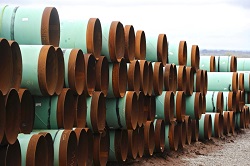
Image – TC Energy said the cause of December’s oil spill in Kansas was caused by a welding flaw and bending pipe stress. Courtesy of: Larry W. Smith/EPA.


For more information:

TC Energy

https://www.tcenergy.com/