Physicists at the University of Warwick, Coventry, U.K., demonstrate a display of modern-day alchemy. A touch of gold—or another noble metal—can change the structure of a crystal and its intrinsic properties, inducing electric effects that were not previously possible, such as converting movement or heat into electricity, by adding metal to their surface.
The method, detailed in Nature, demonstrates effects in crystals with greater magnitude than in conventional bulk materials making it ideal for use in technologies such as sensors, energy conversion, and mobile technologies.
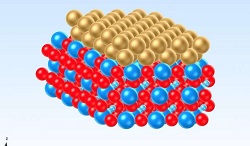
A crystal can function as a semiconductor, allowing an electrical current to flow through it. By adding a small piece of metal to the crystal surface, scientists created a Schottky junction, inducing an electric field into the semiconductor that excites its structure underneath the metal, breaking its symmetry and enabling new effects to occur.
Researchers observed piezoelectric effects, in which movement is converted to electrical energy or vice versa, and pyroelectric effects, where heat is converted to electrical energy. These properties, known as interface effects, are confined in a very shallow region of the crystal, underneath the metals.
The key to the technique is in breaking the symmetry of a crystal’s structure. Dr. Mingmin Yang, who conducted the work at the University of Warwick and has since moved to the Riken institute in Japan, said “Our research is demonstrating that how those elements are arranged is not just determined by their own nature, they can also be tuned by external influence. Once we use that influence to change their arrangement, they can exhibit properties that were previously prohibited to them.”
Using gold and platinum to create junctions on strontium titanate, titanium dioxide, and silicon crystals worked due to their high thermodynamic work functions. Other metals such as copper, silver, or iridium would also be good options. None of these materials would normally show a piezoelectric or pyroelectric effect.
Crystals with piezoelectric effects can harvest energy, or work as an actuator or transducer. With pyroelectric effects, they can work as a sensor or in infrared imaging. These observed effects indicate the technique has great potential for use in sensors which require high sensitivity or in technologies that rely on energy conversion.
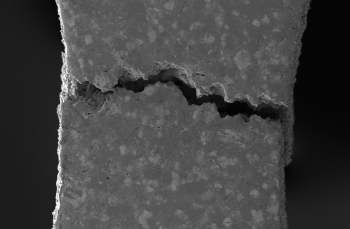
Image – Atomic model of a Au-SrTiO3 Schottky interface. Courtesy of University of Warwick.
For more information:
University of Warwick