The CNRS (Paris, France), l’Université de Lorraine (Nancy, France), and Saint-Gobain Group (Courbevoie, France), created the new Canopée laboratory dedicated to the study of materials and systems under extreme temperature conditions. The objective is to reduce the carbon footprint of high temperature manufacturing processes.
To meet this challenge, this “wall-less” laboratory will bring together material and thermal science experts in France. The initiative is led by Cemhti (in Orléans) and Lemta (CNRS/Université de Lorraine) (in Nancy) of the CNRS1 and two Saint-Gobain research centers (Saint-Gobain Research Provence and Saint-Gobain Research Paris).
Its aim is to combine their expertise through a joint laboratory called Canopée, which stands for “enjeu CArbone: matériaux inNOvants pour des Procédés Economes en Energie” (CArbon stakes: inNOvative materials for Economical Energy Processes).
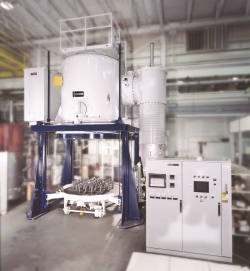
Manufacturing products at high-temperature poses a challenge, as measurement and instrumentation are difficult at the temperatures involved (500-2700°C). The behavior of materials has not always been modeled there, thereby limiting optimization and control during these processes, especially with regard to reducing CO2 emissions.
Created for a period of five years, the goal of Canopée is to establish a greater understanding of thermal transfers—from the scale of the material to that of the industrial installation—as well as develop accurate measurement methods under extreme conditions for the material properties and physical scales characteristic of these processes.
What makes Canopée original is its combination of materials expertise—including the processes for shaping them (on the scale of the laboratory, model, or industrial pilot) and their microstructural characterization (at room temperature or while hot)—with expertise in thermal science, ranging from the accurate measurement of temperature to that of thermo-physical properties of materials (solids or liquids, up to extreme temperatures), in addition to the simulation of thermal transfers.
For more information:
The CNRS
http://www.cnrs.fr/en
Saint-Gobain
https://www.saint-gobain.com/en
Université de Lorraine
https://www.univ-lorraine.fr/