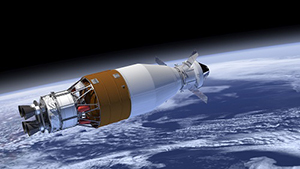
Boeing and NASA have successfully completed a critical design review for NASA’s Space Launch System (SLS) Exploration Upper Stage (EUS), confirming the EUS design for continued development and transition to hardware build. Boeing has already started fabrication activities that will support building the first EUS at NASA’s Michoud Assembly Facility in New Orleans.
The SLS rocket uses staged propulsion to send NASA’s Orion spacecraft and astronauts, plus supplies, to the moon, and beyond. The Boeing-built core stage powers the SLS in early flight, eventually separating when the upper stage takes over and provides the power to send crewed vehicles, space habitats, and other payloads on to the moon or other deep-space destinations.
To accomplish NASA’s Artemis I lunar mission, the Block 1 variant of SLS will use a Boeing/United Launch Alliance Interim Cryogenic Propulsion Stage with one RL-10 engine to take an uncrewed Orion spacecraft on a test flight to the moon. SLS Block 1 rockets will be used for two subsequent crewed flights, including the first human mission to lunar orbit since the Apollo program.
“NASA’s SLS Block 1B with the EUS is capable of sending astronauts and essential supporting cargo to the moon and beyond,” said Steve Snell, EUS program manager for Boeing. “EUS was designed for crewed flights from the beginning, and the additional lift capability that comes with the EUS requires fewer flights to enable a sustained human presence in deep space sooner and more safely.”
For more information: Boeing