Scientists at the Fraunhofer Institute for Laser Technology (ILT), Germany, together with three industrial partners, have developed high-speed laser material deposition process parameters and strategies for coating and repair as well as for hybrid manufacturing of sealing surfaces in its collaborative project EVEREST.
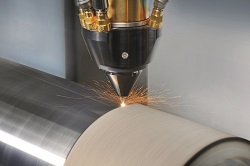
Almost a decade ago, researchers at Fraunhofer ILT developed the extreme high-speed laser (EHLA) material deposition process, which increased the previous process speed from a maximum of two to several hundred meters per minute. The further development and collaborative testing has led to its long-term success.
In the collaboration supported by the European Regional Development Fund, the institute along with German industrial partners LUNOVU GmbH from Herzogenrath, BCT GmbH from Dortmund, and Drink & Schlössers GmbH & Co. KG from Krefeld, Germany, developed process and system technology to efficiently repair and coat components and successfully tested it on rollers.
In one example, a heating roller 1200 mm long and 200 mm in diameter was coated with corrosion-resistant powders based on iron, nickel and cobalt at process speeds of 20 to 200 m/min. The coating thicknesses in the project ranged from 50 to 300 µm.
A specially developed camera module developed by BCT and Fraunhofer ILT performs geometry acquisition, process monitoring, and adaptive tool path planning. It corrects geometric deviations from the target state in a semi-automated manner. Gregor Bultel, a scientist at Fraunhofer ILT explains it doesn’t only close the control loop. “We took a camera-based approach that allows us to follow the coating process from a bird’s eye view, so to speak, and thus draw conclusions about the stability of the process.”
Roll manufacturer Drink & Schlössers took over the practical testing of the pilot system. “With the process and the system technology used, the component surfaces could be processed well,” summarizes Managing Director Kurt Beckers. “We were able to produce the surfaces exactly as we had imagined.” The managing director was already familiar with powder-based laser material deposition, so he was also very interested in the significantly faster version.
Now after successfully completing the project, the Aachen researchers want to establish the newly developed process chain in the industry. The goal is to coat long and large rollers and other rotating components with the EHLA process in a near-net-shape, both reliably and extremely efficiently.
For more information:
Fraunhofer Institute for Laser Technology
https://www.ilt.fraunhofer.de/en.html