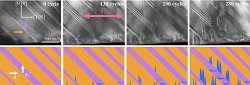
Researchers at University of Sydney, Australia, observed ferroelectric fatigue as it occurred using advanced in-situ electron microscopy in real-time, down to the nanoscale and atomic levels, sparking a new debate on whether interfaces—the physical boundaries separating different regions in materials—are a viable solution to the unreliability of next-generation devices.
Ferroelectric materials are used in many devices, including memories, capacitors, actuators and sensors. These devices are commonly used in both consumer and industrial instruments, such as computers, medical ultrasound equipment and underwater sonars.
Over time, ferroelectric materials are subjected to repeated mechanical and electrical loading, leading to a progressive decrease in their functionality, ultimately resulting in failure. This process is referred to as ferroelectric fatigue.
It is a main cause of the failure of a range of electronic devices, with discarded electronics a leading contributor to e-waste. Globally, tens of millions of tons of failed electronic devices go to landfill every year.
“Our discovery has indicated that interfaces could actually speed up ferroelectric degradation. Therefore, better understanding of these processes is needed to achieve the best performance of devices,” said Dr. Chen from the School of Aerospace, Mechanical and Mechatronic Engineering.
“Although it has long been known that ferroelectric fatigue can shorten the lifespan of electronic devices, how it occurs has previously not been well understood, due to a lack of suitable technology to observe it,” said Dr. Qianwei Huang, the study’s lead researcher.
“Our discovery is a significant scientific breakthrough as it shows a clear picture of how the ferroelectric degradation process is present at the nanoscale,” said co-author Professor Xiaozhou Liao, also from the University of Sydney Nano Institute.
The researchers hope this new observation, described in a paper published in Nature Communications, will help better inform the future design of ferroelectric nanodevices with longer lifespans.
Image – Electron microscopy images show the degradation in action. Courtesy of the University of Sydney.
For more information:
University of Sydney
https://www.sydney.edu.au/