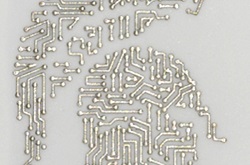
Researchers at Michigan State University (MSU), East Lansing, MI, developed a process to create more resilient circuitry, which they demonstrated by creating a silver Spartan helmet.
The types of devices that the MSU team is working to benefit—next-generation fuel cells, high-temperature semiconductors and solid oxide electrolysis cells—could have applications in the auto, energy and aerospace industries.
To help prototypes become commercial products, though, they’ll need to maintain their performance at high temperatures over long periods of time, said Nicholas, an associate professor in the College of Engineering. He was drawn to this field after years of using solid oxide fuel cells, which work like solid oxide electrolysis cells in reverse. Rather than using energy to create gases or fuel, they create energy from those chemicals. Fuel cells need to withstand intense working conditions, typically operating around 700 to 800 degrees Celsius or 1,300 to 1,400 degrees Fahrenheit, for a long time, which can be 40,000 hours over their lifetime.
“Over that lifetime, you’re thermally cycling it,” Nicholas said. “You’re cooling it down and heating it back up. It’s a very extreme environment. You can have circuit leads pop off.”
One of the hurdles facing this advanced technology is rather rudimentary. The conductive circuitry, often made from silver, needs to stick better to the underlying ceramic components. The secret to improving the adhesion, the researchers found, was to add an intermediate layer of porous nickel between the silver and the ceramic.
By performing experiments and computer simulations of how the materials interact, the team optimized nickel deposition on the ceramic. To create the thin, porous nickel layers on the ceramic in a pattern or design of their choosing, the researchers turned to screen printing, the same procedure used to make printed T-shirts.
Once the nickel is in place, the team puts it in contact with silver that’s melted at a temperature of about 1,000 degrees Celsius. The nickel not only withstands that heat—its melting point is 1,455 degrees Celsius—but it also wicks up and distributes the liquefied molten silver uniformly over its fine features using capillary action.
After the silver cools and solidifies, the nickel keeps it locked onto the ceramic, even in the 700 to 800 degree Celsius heat it would face inside a solid oxide fuel cell or a solid oxide electrolysis cell. And this approach also has the potential to help other technologies, where electronics can run hot.
The group is working to commercialize Spartan innovations and patent this process for creating tougher electronics.
Image – MSU researchers developed a more heat resilient silver circuitry with an assist from nickel, which they demonstrated by creating a silver Spartan helmet. Circuit designed by Jane Manfredi, an assistant professor in the College of Veterinary Medicine. Courtesy of Acta Materialia Inc./Elsevier.
For more information:
Michigan State University
https://msu.edu/