As the battle against COVID-19 persists, some scientists continue to study how long viruses remain infective on material surfaces. The consensus is that the duration of infectivity varies depending on the specific material. In this digital-first article from Advanced Materials & Processes, ASM International’s flagship magazine, Hideyuki Kanematsu and his international team explain various methods for evaluating the behavior of viruses on material surfaces. They also look at ways to design and develop advanced antiviral materials going forward.
Read the full digital-first article, which will also be published in the July/August 2021 issue of Advanced Materials & Processes (AM&P) magazine.
This article is the tenth installment in an AM&P series on materials science and the coronavirus.
About the Authors
Hideyuki Kanematsu and Risa Kawai, National Institute of Technology (KOSEN), Suzuka College, Japan
Dana M. Barry, Clarkson University and SUNY Canton, New York
Eri Nakajima and Yasuo Imoto, Japan Textile Products Quality and Technology Center
************
About ASM International
ASM International is a member-driven organization that serves the information needs of scientists, engineers, and technicians who develop, test, select, and apply advanced materials, including metals, composites, polymers, and ceramics. As the world’s largest and most established materials information society, ASM engages and connects members to a global network of peers and provides access to trusted materials information through reference content and data, education courses, international events, and applied research.
To learn more about ASM International, visit asminternational.org or call 440.671.3800 to speak with an ASM International representative.
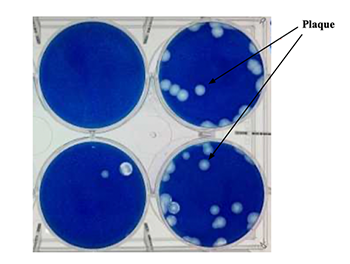
Image–A plaque assay. The number of plaque shapes is countable and the logarithmic number is defined as infectivity.
************
For more information:
Hideyuki Kanematsu
Previous articles in the Materials Science and the Coronavirus Series:
Can Copper Help Fight COVID-19?
Copper’s Conductivity and Antimicrobial Properties Inspire Renewed Interest
Antimicrobial Copper-Containing Stainless Steels Show Promise
Using Digitally Distributed Manufacturing to Address Critical Needs
Development and Validation of High-Performance SARS-CoV-2 Antiviral Coatings for High-Touch Surfaces
Supersonically Deposited Antiviral Copper Coatings
Optimizing 3D-Printed, Reusable Metal N95 Filters by 3D Characterization and Modeling