The most important function of alloying elements in heat treatable steels is to increase hardenability, whether for quench and tempering or sinter hardening. Adding copper increases both hardness and tensile strength in the sintered condition.
When heat treated, it increases the depth of hardness but reduces toughness and elongation. As copper content increases, rupture strength increases to an optimum level and then declines. This increase in hardenability makes possible the hardening of larger sections and the use of oil rather than water quench to minimize distortion and avoid quench cracking. Increasing the carbon content of steel raises the tensile strength and hardness levels in proportion to the amount of carbon. In wrought steel, the ratio is about 1.2% C.
In sintered powder metallurgy steels, the maximum tensile strength is reached at the eutectoid composition of 0.8% C. When the carbon content is increased above this level, carbide networks begin to form at grain boundaries and along porosity channels, which causes embrittlement and loss of strength. As alloying elements such as nickel, molybdenum, chromium, and copper are added, the optimum carbon level content is lowered. In sintered steels, the most common alloying elements are copper and nickel.
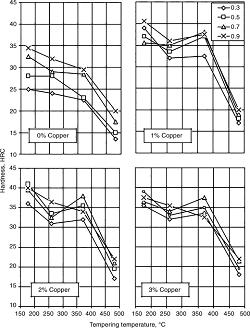
In the plain iron-carbon (Fe-C) system, peak strength occurs near the eutectoid composition in the as-sintered condition and at approximately 0.65% C in the heat treated condition. Fe-C systems soften progressively as the tempering temperature is raised, whereas iron-carbon-copper (Fe-C-Cu) systems show significant temper resistance up to 370°C (700°F) (Ref 10). The figure shows the effect of tempering temperature and composition on hardness for Fe-C and Fe-C-Cu systems.
For more information, click on the link below (subscription required). Then scroll to Figure 11.
Joseph W. Newkirk, Heat Treatment of Powder Metallurgy Steels, Heat Treating of Irons and Steels, Vol 4D, ASM Handbook, Edited By Jon L. Dossett, George E. Totten, ASM International, 2014, p 253-273, https://doi.org/10.31399/asm.hb.v04d.9781627081689.