Cardiovascular disease (CVD) — a general term for a range of conditions affecting the heart and blood vessels, including heart failure, arterial disease, and stroke — is the leading cause of death globally, accounting for the loss of almost 18 million people in 2016 alone. By 2030 the cost of CVDs in terms of mortality is expected to rise to around 24 million deaths worldwide.
Thus tackling CVD efficiently is a major concern for health care providers, with a key factor in preventing heart failure during these events being the quick restoration of blood flow to the heart.
Currently, the best way of doing this is revascularization by either placing a stent or by performing a surgical bypass. This latter technique hinges on the use of autologous vessels to bypass diseased or blocked arteries. But the procedure is not without risk. Harvesting vessels for use in this procedure is invasive and not without risk. Even after successful harvesting, the possibility remains that the vessels will be usable.
There is a possible alternative, however. Researchers are currently hard at work developing synthetic vascular grafts. For maximum effectiveness, these grafts should be flexible with adjustable size and length, be ready for use in a practical setting, and crucially made from biodegradable materials.
Current polymers used for artificial grafts have exceptional biocompatibility, chemical stability with low toxicity, and robustness that makes them a long-term solution. Unfortunately, as well as lacking that crucial biodegradability, these materials have thus far proven to have limited success when used to replace smaller blood vessels.
One solution to these issues is the creation of grafts that can be embedded with antithrombotic drugs. Alternatively, materials could be combined to create a graft that gradually degrades and is replaced by natural blood vessels.
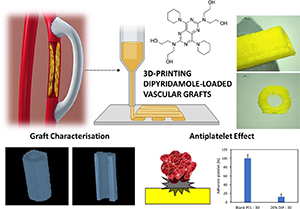
A new paper published in the journal Materials Science and Engineering: C suggests a biodegradable, non-toxic, artificial vascular graft made from polycaprolactone (PCL) that has the potential to degrade gradually and thus allow the regeneration of blood vessels. The material has already been approved for use as a biomaterial in implants and for drug delivery.
The authors of the study aimed to put 3D-printed PCL-based vascular grafts loaded with dipyridamole (DIP), a widely used antithrombotic drug , to the test.
For more information: Materials Science and Engineering: C