An international group of geochemists have discovered why gold is concentrated alongside arsenic, explaining the formation of most gold deposits. This may also explain why many gold miners and others have been at risk from arsenic poisoning. The team studied the action of the gold-concentrating minerals using the intense x-rays beam produced by the European Synchrotron (ESRF) at Grenoble in France, which can probe the chemical bonds between the mineral and gold.
Some gold is found as gold nuggets, but an appreciable amount is bound up with minerals. Gold is known to be related to iron- and arsenic-containing minerals, such as pyrite and arsenopyrite. These minerals act sort of like a sponge, and are capable of concentrating gold up to 1 million times more than is found elsewhere in nature, such as in the hot spring waters that transport gold. This gold becomes chemically bound in these minerals, so it is invisible to the naked eye.
The scientific team found that when the mineral is enriched with arsenic, gold can enter mineral structural sites by directly binding to arsenic (forming, chemically speaking, Au(2+) and As(1-) bonds), which allows gold to be stabilized in the mineral. However, when the arsenic concentration is low, gold doesn’t enter the mineral structure but only forms weak gold-sulfur bonds with the mineral surface.
Lead researcher, Dr. Gleb Pokrovski, director of research at CNRS, GET-CNRS-University of Toulouse Paul Sabatier, said, “Our results show that arsenic drives the concentration of gold. This arsenic-driven gold pump explains how these iron sulfides can massively capture and then release gold, so controlling ore deposit formation and distribution. In practical terms, it means that it will make it easier to find new sources of gold and other precious metals, which bind to arsenic-containing iron sulfides. It may also open the door to controlling the chemical reactions, and if we can improve gold processing, we can recover more gold.”
The noxious link between arsenic and gold is well-known in France and elsewhere in the world, including at the Salsigne mine near Carcassonne. This was one of Western Europe’s largest gold mines, and the world’s largest arsenic producer at one time. It closed in 2004, but the environmental consequences of the arsenic pollution still persist in the region.
Dr. Jeffrey Hedenquist, University of Ottawa, said, “Geologists as well as prospectors have long known that gold can be associated with arsenic-rich minerals, and over the past few decades, others have quantified this association. The findings of Dr. Pokrovski and his team now help to explain why we see this association, caused by an atomic-scale attraction between gold and arsenic, with this marriage arranged by the structure of certain minerals.”
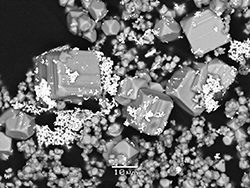
Image – Scanning electron microscopy photomicrograph showing gold microparticles (bright color) deposited with pyrite crystals from a hydrothermal solution in a laboratory experiment. Such experiments simulate the formation of gold deposits in nature. Courtesy of Maria Kokh and Gleb Pokrovski.
************
For more information: